
The Future of Hair Loss Treatment 🔬 15 Emerging Therapies and Research Areas to Watch in 2026
- Hairline Illusions

- Jan 8
- 3 min read
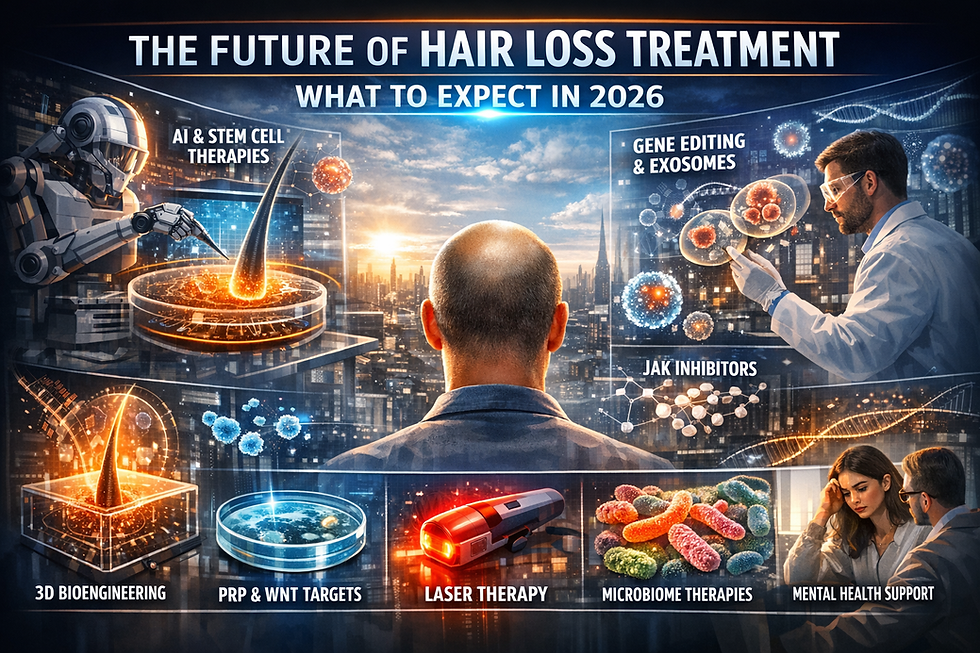
As we stand on the brink of 2026, the landscape of hair loss treatment is poised for a revolution. Researchers and scientists worldwide are tirelessly working to develop innovative therapies and technologies that promise to transform the lives of millions affected by hair loss. While these emerging areas show immense potential, it is essential to note that they are still in various stages of research and development and have not yet been proven effective or gained regulatory approval. In this article, we will explore 15 exciting frontiers that may shape the future of hair loss treatment.
AI-Guided Precision Medicine: Harnessing the power of artificial intelligence, researchers are developing sophisticated algorithms to analyze individual patient data, aiming to predict the most effective personalized therapies for hair loss.
Exosome-Based Regenerative Therapies: Exosomes derived from stem cells are showing remarkable promise in promoting hair growth, with early-stage clinical trials underway to evaluate their safety and efficacy.
Advanced Tissue Engineering: Scientists are pushing the boundaries of regenerative medicine by creating 3D-printed, bioengineered hair follicles that could potentially provide an unlimited source of transplantable hair.
Next-Generation JAK Inhibitors: Building upon the success of the first wave of JAK inhibitors, researchers are developing new iterations with enhanced selectivity and fewer side effects for more targeted immunomodulation in hair loss disorders.
Microbiome-Based Therapies: As we unravel the intricate relationship between the scalp microbiome and hair health, scientists are paving the way for probiotic and prebiotic interventions to optimize the scalp environment for hair growth.
Platelet-Rich Plasma (PRP) Therapy Optimization: Researchers are fine-tuning PRP protocols to enhance consistency and efficacy in promoting hair growth, exploring optimal platelet concentrations, activation methods, and injection techniques.
Wnt Pathway Modulation: The Wnt signaling pathway, a crucial player in hair follicle development, is being targeted with small molecule activators and inhibitors of Wnt antagonists as potential therapeutic agents for hair loss.
Epigenetic Therapies: Scientists are investigating epigenetic modifications, such as histone deacetylase inhibitors and DNA methyltransferase inhibitors, to reprogram the epigenetic landscape of hair follicles and promote regeneration.
Extracellular Matrix (ECM) Targeting Therapies: Recognizing the vital role of the ECM in hair follicle function, researchers are developing therapies that target specific ECM components to foster a more favorable microenvironment for hair growth.
Non-Invasive Low-Level Light Therapy (LLLT) Advancements: Ongoing research aims to optimize LLLT treatment parameters and enhance efficacy, exploring novel light sources and synergistic effects with other hair growth promoters.
Exosome-Based Diagnostics: Exosomes are being explored as diagnostic biomarkers for the early detection and classification of hair loss disorders, offering the potential for non-invasive and precise diagnostic tools.
Microbiome-Based Diagnostics: Researchers are investigating the potential of microbiome-based diagnostics, profiling the scalp microbiome composition to aid in the personalized assessment and treatment of hair loss.
Machine Learning for Treatment Optimization: By leveraging machine learning algorithms to analyze vast datasets, scientists aim to identify patterns and predict the most effective treatment strategies for individual patients.
Psychosocial Support and Mental Health Resources: Recognizing the profound psychological impact of hair loss, there is a growing emphasis on integrating psychosocial support and mental health resources into comprehensive hair loss management.
Stem Cell-Derived Exosome Therapy: Researchers are exploring the use of exosomes derived from stem cells as a potentially safer and more scalable approach to hair regeneration, harnessing the regenerative potential of stem cells without direct cell transplantation.
As we eagerly await the dawn of 2026, these emerging therapies and research areas offer hope and promise for those struggling with hair loss. While the path from laboratory to clinic is long and complex, the tireless efforts of scientists and researchers bring us closer to a future where personalized, effective, and transformative hair loss treatments are a reality. As always, it is crucial to consult with a qualified healthcare professional to discuss the most appropriate and evidence-based treatment options currently available.
#HairLossTreatment #EmergingTherapies #HairResearch #PrecisionMedicine #RegenerativeMedicine #HairRestoration #FutureOfHairLoss #2026Outlook
©2026 Hairline Illusions™ No portion of this article or any content on this website—including but not limited to text, images, terminology, research findings, methodologies, or original concepts—may be copied, reproduced, distributed, republished, downloaded, displayed, posted, transmitted, or used in any form or by any means, including photocopying, recording, or other electronic or mechanical methods, without the prior written permission of Hairline Illusions / HIASTI.
This prohibition expressly includes the use of artificial intelligence (AI) tools, large language models, or any automated systems to copy, paraphrase, rewrite, summarize, or create derivative works based on this content.
For permission requests, contact: info@hairlineillusions.com
Unauthorized use may result in legal action.


Comments