
Is Your Wig Hurting the Hair Underneath?

We love our wigs, and they can be a true protective style. But tight braids, glue, and constant wear can quietly damage the hair and scalp underneath, and most of that damage is reversible only if it is caught early.
What traction alopecia is
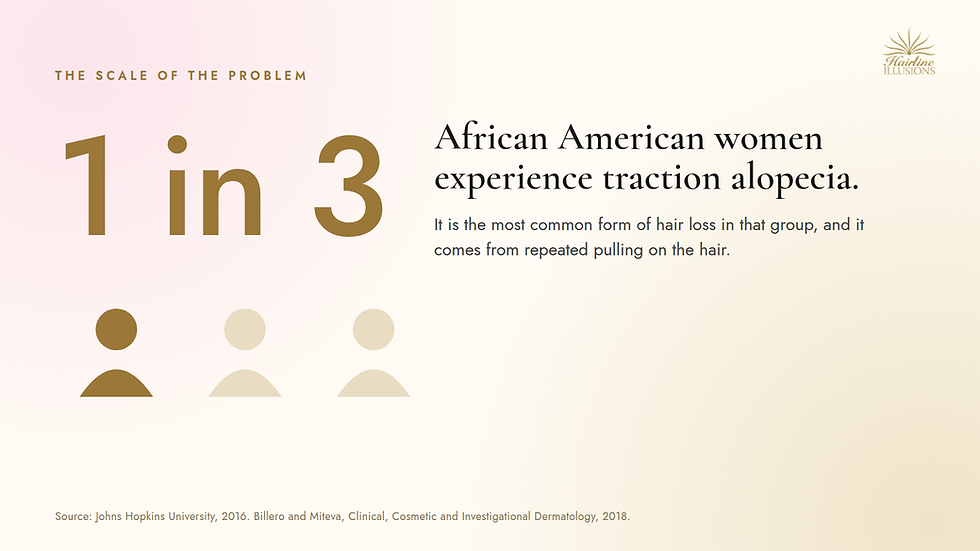
Traction alopecia is hair loss caused by repeated pulling on the hair. It is the most common form of hair loss among African American women, affecting an estimated one-third of them, according to dermatologists at Johns Hopkins.
It is not limited to one group. Dermatologists have documented it in Hispanic women who wear tight ponytails, Sikh men and Turkish women who wear turbans, nurses who wear caps, and ballerinas who wear tight buns. Anyone whose hair is pulled the same way, day after day, is at risk.
The danger is that it often builds slowly. Many women do not notice until their edges have visibly thinned.
How wigs can contribute
A wig itself is not the problem. The risk comes from how the hair underneath is prepared, how the unit is secured, and how long it stays on.
What goes underneath. Researchers at Johns Hopkins found the highest-risk styles include braids, locs, weaves, and extensions, especially when applied to chemically treated hair. Tight cornrows under a wig pull on the same follicles for weeks at a time.
How it is secured. Dermatologists have documented hair loss along the hairline after a glued wig was removed. Long-term use of wefts, a component of weaves, has been described as causing a horseshoe-shaped pattern of hair loss.
Weight and constant wear. One published case describes a ballerina who wore a 1.5-pound hairpiece every day for two years to cover her hair loss. The added weight and pull made her hair loss worse, not better.
The lesson: a unit worn to hide thinning can deepen it, if the fit and the foundation underneath keep pulling.
Adhesives and the scalp
Glue brings a second risk beyond pulling: the skin can react to it.
Allergic contact dermatitis caused by an acrylate-based hair prosthesis fixative has been reported in the medical journal Contact Dermatitis. Reactions to cyanoacrylate adhesives, the family that includes superglue, are also documented in dermatology literature.
The American Academy of Dermatology advises choosing sewn-in weaves over ones that use bonding glue, and removing any style right away if it causes pain or irritates the scalp. For wig wearers, that makes glue-free options such as adjustable bands, combs, and clips the gentler choice for the hairline.
The early warning signs
The earliest sign of traction alopecia is redness around the hair follicles, which can develop into small bumps and pustules, a condition called folliculitis.
Watch for:
Pain or tenderness during or after styling. In one group of patients with traction alopecia, only 18.9% said they had never felt pain during or after hairdressing.
Redness or small bumps around the follicles, especially at the hairline.
Broken hairs of different lengths in one area.
The fringe sign: a thin strip of hair left along the very edge of the hairline, with thinning behind it.

If a style hurts, it is pulling too hard. Pain is a warning, not a normal part of wearing a unit.
Caught early vs. caught late
Most cases of traction alopecia can be reversed if action is taken early. In its later stages, if the pulling continues, it can progress to permanent scarring hair loss.

The first step at every stage is the same: relieve the tension on the hair. From there, dermatologists may use:
Topical or injected corticosteroids at the edge of the hair loss, to calm inflammation.
Oral or topical antibiotics, used for their anti-inflammatory effect.
Topical minoxidil. In two published cases of late-stage traction alopecia, 2% minoxidil led to regrowth at 3 months and significant regrowth at 6 and 9 months.
Hair transplantation for advanced cases, which has been done successfully with several grafting techniques.
These are decisions for a dermatologist. The point for wig wearers is simple: the earlier the pulling stops, the more of your own hair you keep.
How to wear wigs and protect the hair underneath
These swaps come from dermatology guidance on reducing tension, glue, and friction.

Instead of | Try |
Tight braids or cornrows underneath | Loose braids, especially around the hairline |
Thin, tight braids | Thicker braids, kept short so they weigh less |
The same style for months | Rotating styles so follicles can recover |
Braids left in indefinitely | Removing braids every 2 to 3 months |
Glued units at the edges | Sewn-in or glue-free: bands, combs, clips |
Wearing through pain or irritation | Removing the unit right away and resting the scalp |
Rough liners or coverings | Silk or satin, which is gentler on hair |
Hair pulled tight under the cap | Hair pulled back loosely underneath |
The AAD also notes that wigs and scarves can be part of the solution: they can protect your hair while it recovers, as long as what sits underneath is not pulling.
When to see a dermatologist
Book a visit if you notice thinning edges, a fringe of hair along the hairline, bumps or redness that do not settle, or pain that comes back each time you put your unit on. A dermatologist can confirm the cause and start treatment while the hair loss can still be reversed.
How we build for healthy hair
At Hairline Illusions, we build custom systems made to each client's head, with glue-free securing options, so the fit holds without pulling. Your wig should protect your hair, not cost you your hair.
(866) 777-7567 | hairlineillusions.com
This article is for education and does not replace an evaluation by a dermatologist.
References
Billero V, Miteva M. Traction alopecia: the root of the problem. Clinical, Cosmetic and Investigational Dermatology, 2018.
Johns Hopkins University Hub. Some popular hairstyles could lead to hair loss, Johns Hopkins dermatologists warn. 2016.
Haskin A, Aguh C. All hairstyles are not created equal: What the dermatologist needs to know about black hairstyling practices and the risk of traction alopecia. Journal of the American Academy of Dermatology, 2016.
American Academy of Dermatology. Hairstyles that pull can lead to hair loss.
Ródenas-Herranz T, et al. Acrylate allergic contact dermatitis caused by hair prosthesis fixative. Contact Dermatitis, 2020.
Allergic contact dermatitis to superglue. International Journal of Trichology.
© Hairline Illusions™ | HIASTI | Hair & Wig Science Series. All rights reserved.


Comments