
Caring for the Scalp Under a Topper

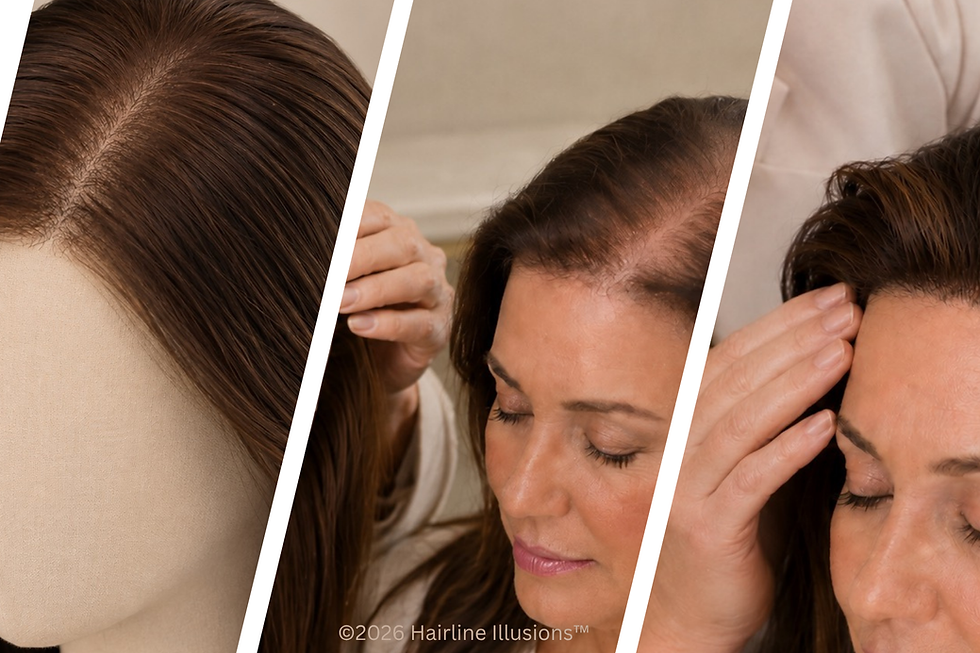
Protecting the Scalp Under an Attached System
A Professional Guide to Clips, Microlinks, Sew-Ins, and Adhesives
Hairline Illusions Arts, Science, and Technology Institute
When we attach a topper or hair system to a client, we take on responsibility for more than the hair they see. We become responsible for the skin underneath. The scalp is living tissue, and every attachment method, clips, microlinks, sew-ins, and adhesives, places its own demands on that tissue. A method that serves one client well can harm another, depending on the health of the scalp, the tension applied, and the care that follows.
This guide is for professionals who want to protect the scalp, not just secure the hair. The principle behind all of it is simple. The hair is what the client wears. The scalp is what they keep.
One note on scope before we begin. As hair replacement professionals, we do not diagnose or treat medical conditions of the scalp. Our role is to choose and maintain attachments that protect the scalp, to recognize the early signs that something is wrong, and to refer the client to a dermatologist or physician when a condition needs medical evaluation. Throughout this guide, where we describe a sign to watch for, the responsible next step is referral, not diagnosis.

The Two Risks That Run Through Every Method
Before the individual methods, two risks deserve attention because they appear across all of them.
Tension and traction. Constant pulling on the same follicles can lead to traction alopecia, a form of hair loss caused by sustained stress on the hair and scalp. It is most associated with tight styles and attachments worn in the same position over time. A properly fitted system applied with correct tension does not cause this damage. The harm comes from incorrect use: a base too small, clips set in the same spot daily, or tension set too high at install.
Hygiene and occlusion. Any system that covers the scalp can trap heat, sweat, oil, and product. When the scalp cannot breathe or be cleaned, that environment invites irritation, buildup, and in some cases inflammation or infection. Methods that leave the scalp accessible are generally easier to clean and monitor than methods that fully cover or bond over the scalp.
Clips
Clips are the most common attachment for toppers and the easiest for clients to manage at home. They are also the method most associated with localized tension, because the entire hold rests on a few small points gripping the client's own hair.
The risk. Clips concentrate stress on the follicles they grip. Worn in the same position every day, on a base that is too small, or over thinning areas, they can pull on already vulnerable hair and contribute to traction alopecia.
How we protect the scalp. Choose a base large enough that the clips sit on stable hair, not on the thinnest zones. Rotate the clip positions so the same follicles are not stressed daily.
Set the tension so the piece feels secure without dragging. For clients prone to tension loss, a lighter base reduces pull, and an adjustable band or wire can take pressure off the clips entirely. Teach the client to remove the system at night so the scalp gets daily relief.
Microlinks
Microlinks, also called beads or i-tips, attach hair to small sections of the client's own hair with tiny links, without braids, glue, or sewing. For scalp health, this method has a real advantage: it leaves the scalp open and accessible.
The advantage. Because nothing seals the scalp, the client can wash, condition, oil, and massage the scalp while the system is in. That access makes ongoing scalp care far easier than with covered methods, which matters especially for clients who sweat, exercise, or have scalp conditions to manage. Microlinks also avoid adhesives entirely, which removes the chemical-reaction risk that comes with glue.
The risk. The links still place tension on the small sections of hair they grip. Beads set too tightly, or links left in too long without adjustment, can strain the natural hair and cause breakage or discomfort at the root.
How we protect the scalp. Set the links with low, even tension. Reposition or tighten only as needed, and check the grip at maintenance visits. Direct washing to flow straight down the link rather than scrubbing the bead area, and teach the client to detangle gently from the ends up. Keep to a maintenance schedule so links are adjusted before they migrate and pull.
A caution for washing. Take extra care washing hair that carries links or a topper, because hair is at its most vulnerable when wet. Water breaks the hydrogen bonds that give the strand its strength, and wet hair loses a significant portion of its tensile strength, stretching more easily and snapping under tension that dry hair would tolerate. Now add the weight of the links and the topper hair, and wet strands are carrying extra load at the exact moment they are weakest, which pulls on the roots and can break the hair. Support the weight while washing rather than letting it hang and drag, wash gently in a downward motion, never wring or rough-dry, and let the hair dry before any brushing or styling. This single habit prevents a great deal of the breakage and thinning that clients otherwise blame on the system itself.
Sew-Ins
Sew-ins attach wefts to the client's hair, traditionally onto braided cornrows, without adhesives. The method is valued as a protective style because it tucks the natural hair away, but that same coverage is what raises the scalp-care demand.
The risk. Two issues stand out. First, tension: braids and wefts that are too tight place sustained stress on the hairline and follicles, a leading contributor to traction alopecia. Second, hygiene: the braided, covered scalp is harder to clean and dry, so sweat, product, and buildup can accumulate underneath, leading to itching, odor, and inflammation if neglected.
How we protect the scalp. Braid and sew with moderate tension, never tight, with particular care at the fragile hairline. Keep the foundation clean and ensure the scalp can be reached for washing and dried fully afterward. Set a realistic wear limit and maintenance interval rather than leaving a sew-in in until it loosens. Watch the perimeter for any sign of tension stress and adjust the plan if you see it.
Adhesives: Glue and Tape
Adhesives create the flattest, most secure, most undetectable hold, which is why they are chosen for active wear and for the most natural finish. They also carry the highest skin-safety burden of any method, because a chemical sits in direct, prolonged contact with the scalp.
The risk. Adhesives are a documented cause of both irritant and allergic contact dermatitis.
The reaction depends on the specific chemicals in the product and on the individual's sensitivity, and it can range from redness and itching to oozing, blistering plaques. The medical literature includes cases of allergic contact dermatitis traced directly to wig adhesive, with reactions confined to exactly where the glue was applied. Some adhesives and weft glues also contain ingredients such as latex, rubber, and dyes that are known sensitizers. Adhesives are also the hardest method to remove, requiring solvents that add their own contact with the skin.
How we protect the scalp. Always perform a skin patch test before the first application of any new adhesive or tape, on a small area of skin, read at 48 and 72 hours, because a reaction to one product does not predict reactions to another. Apply a scalp protector as a barrier between skin and adhesive when appropriate. Remove with the correct solvents rather than pulling, and give the scalp recovery time between applications. For any client with broken skin, an active scalp condition, or a sensitive or medically compromised scalp, adhesives are the method to approach with the most caution, and sometimes to avoid entirely in favor of a gentler attachment.

Long-Term Adhesive Wear: What Happens Past a Week
Adhesive worn continuously for extended periods, beyond a week without removal, is where the real damage to the scalp and the client's own hair tends to begin. The harm is rarely from a single application. It is the compounding effect of pressure, occlusion, and chemical contact day after day.
What can happen over time. Three things accumulate under long uninterrupted adhesive wear. First, traction: the constant pull of a bonded system on the perimeter and the client's own hair places sustained tension on the follicles, and that micro-tension compounding over weeks and months is a leading path to traction alopecia, the gradual thinning seen most at the edges, temples, and nape. Second, occlusion: adhesive seals the scalp, trapping sweat, oil, and product against skin that cannot breathe or be cleaned, which fosters irritation, buildup, folliculitis, and inflammation. Third, chemical exposure: prolonged uninterrupted contact with the adhesive raises the likelihood of irritant or allergic contact dermatitis, and each removal adds solvent contact and the risk of mechanical pulling. Together these can disrupt the hair growth cycle, and continued shedding and thinning is the warning sign that the scalp is under more stress than it can recover from.
Why the hair keeps shedding and thinning. When shedding does not stop, it is usually one of these causes still in play: tension that was never reduced, a scalp that is never fully cleaned or rested, or an ongoing low-grade inflammation from trapped buildup or chemical irritation. Early traction can recover once the tension is removed, but long-standing traction and untreated inflammation can lead to scarring and permanent loss. The goal is to catch and correct it while it is still reversible.
Best practices for safe long-term wear. The most important habit is a deliberate wear limit. As a general professional safety guideline, many specialists do not exceed one to two weeks of continuous semi-permanent adhesive wear without a complete removal, a deep cleanse of the scalp, and a rest period for the skin before reapplying. Always follow the manufacturer's instructions for the specific adhesive in use, since recommended wear times vary by product, and adjust shorter for sensitive or compromised scalps. Build a removal-and-rest cycle into the client's maintenance schedule rather than leaving the system on until it fails. Always use a scalp protector as a barrier under the adhesive. Rotate or alternate adhesives and allow periodic adhesive-free intervals to reduce sensitization. Keep tension moderate and the perimeter loose enough to protect the fragile hairline. Cleanse the scalp thoroughly at every removal so buildup never accumulates. And teach the client a simple check-in routine, watching the edges, tension, comfort, and any irritation, so problems are caught early. If shedding, a receding edge, or smooth shiny patches appear, the responsible step is to pause the adhesive method and refer the client to a dermatologist for evaluation before lasting damage sets in. Recognizing the sign is our job. Diagnosing the cause is theirs.
Matching the Method to the Scalp
No single method is best for every client. The right choice depends on the scalp in front of you.
For a sensitive, healing, or medically compromised scalp, including clients navigating cancer treatment, alopecia, or dermatitis, the priorities are breathability, low tension, and minimal chemical contact. Methods that leave the scalp accessible and avoid adhesives are generally the safer starting point, and any material in contact with the skin should be appropriate for that contact. For a healthy scalp and an active client who wants the most secure, undetectable hold, adhesives may be appropriate, provided the client has been patch tested and the scalp is monitored.
Whatever the method, the same habits protect the client: correct tension, a clean and breathable scalp, scheduled maintenance, daily or regular relief from the attachment, and patch testing before any adhesive. We watch the scalp at every visit. The moment we see stress, irritation, or change we cannot resolve through our own adjustments, we pause and refer the client to a licensed medical professional. Protecting the scalp sometimes means knowing when the next step is not ours to take.
The skill in our work is not only making hair look right today. It is choosing and maintaining an attachment that protects the scalp and the client's own hair over the long term. We do not diagnose or treat medical conditions. What we do is recognize when something looks wrong, adjust our work to protect the scalp, and guide the client to a licensed medical professional when a condition needs evaluation. That judgment, knowing what we handle and what belongs with a dermatologist or physician, is the standard we teach.
Go Deeper: The Science of Wig Foundations
This guide covers the scalp-care principles behind each attachment method. For professionals who want to understand the foundations themselves at a deeper level, how a base is engineered, how different constructions interact with the scalp, and how foundation choices shape comfort, breathability, and long-term scalp health, we wrote The Science of Wig Foundations.
It is the first volume in our Hair and Wig Science Series, written to give specialists the clinical and technical grounding that most training leaves out. The deeper your understanding of the foundation, the better every decision you make for the scalp underneath it. Professionals can find the volume through our institute.
References and Sources
Traction alopecia (TA) is a hair loss condition caused by prolonged tension, hair shaft trauma, and sustained pulling, leading to follicle loosening and perifollicular inflammation; while often categorized as nonscarring, late-stage TA can cause permanent loss and scarring from chronic folliculitis and sustained tension, and early intervention is needed to prevent progression (Billero and Miteva, Management of Traction Alopecia, Journal of Drugs in Dermatology, 2021, PMID 33938696; Pulickal and Kaliyadan, peer-reviewed dermatology literature). Hairstyling practices that apply sustained traction, including extensions and attached wefts, are an established risk factor, and weft hair extensions have been documented to cause a distinctive pattern of traction alopecia (Haskin and Aguh, All hairstyles are not created equal, Journal of the American Academy of Dermatology, 2016, PMID 27114262; Ahdout and Mirmirani, Weft hair extensions causing traction alopecia, JAAD, 2012). Risk of TA increases with the extent of pulling, the duration of traction, and chemical processing (Gavazzoni Dias et al., Traction Alopecia: The Root of the Problem, Clinical, Cosmetic and Investigational Dermatology, 2018). For attachment-specific guidance, properly fitted and correctly applied systems with moderate tension reduce risk, while too-small bases, repeated clip placement on the same or thinning areas, and excessive weight on fine strands increase it; rotating positions and choosing a larger or lighter base help (industry application guidance, UniWigs, 2023 to 2025). Adhesives can cause irritant or allergic contact dermatitis depending on the chemicals present and individual sensitivity; a documented case describes allergic contact dermatitis from wig adhesive, with an itchy, oozing plaque confined to the application area, resolved by discontinuing use and treating with topical corticosteroids (Allergic Contact Dermatitis to Superglue, National Library of Medicine, PMC). A skin patch test before first use, read at 48 and 72 hours, is recommended because sensitivity to one product does not predict another, and a barrier scalp protector reduces direct contact (manufacturer adhesive safety guidance; patch-test standard consistent with dermatologic practice). Regarding wet hair, water temporarily disrupts the hydrogen bonds within the hair shaft, causing the fiber to swell, the cuticle to lift, and the strand to become more elastic and significantly weaker in tensile strength, so wet hair is more prone to stretching and breakage under tension and added weight; published figures for the loss of wet tensile strength vary by source and method, and the practical guidance is to minimize tension and mechanical stress on wet hair (consumer and trade hair-science references; figures vary). Trapped sweat, heat, oil, and product buildup under continuously worn or bonded systems can contribute to irritation, folliculitis, and inflammation, and occlusion is a recognized factor in scalp conditions (dermatologic literature on folliculitis and occlusion). On long-term adhesive wear, professional guidance commonly advises periodic full removal, deep cleansing, and a skin rest interval rather than uninterrupted wear, with exact intervals varying by product; always follow the manufacturer's stated wear time for the specific adhesive (industry best-practice guidance, WigSuperstore, 2026). This guide is educational and reflects professional best practice for hair replacement specialists. It does not constitute medical advice, diagnosis, or treatment, and does not replace individualized evaluation by a licensed medical provider. Clients with active scalp conditions, persistent shedding, or signs of inflammation should be referred to a dermatologist or physician.
© 2026 Hairline Illusions Arts, Science, and Technology Institute (HIASTI). All rights reserved. This article may not be reproduced or distributed without prior written permission, except brief quotations for review or scholarly use.
This content is for professional education only and does not constitute medical advice, diagnosis, or treatment. Hairline Illusions and HIASTI provide cranial prosthetics and education. We do not diagnose or treat scalp or medical conditions. Please refer clients to a licensed dermatologist or physician for medical evaluation.


Comments