
Before You Buy a Cranial Prosthesis What Every Family Should Know

Before you choose a cranial prosthesis (hair prosthesis, Medical wig)

learn how to choose one.
A cranial prosthesis can restore much more than the appearance of hair.
For someone living with alopecia, chemotherapy-related hair loss, scarring hair loss, trauma, or another medical condition, the right prosthesis can make everyday life easier. It can mean going to school without worrying about questions, working without wondering whether the hair will shift, exercising, traveling, attending an event, or simply looking in the mirror and recognizing yourself.
But choosing one can also be overwhelming.
There are different foundations, attachment methods, hair types, construction techniques, densities, maintenance schedules, and price points. Two systems that look similar in photographs may feel completely different after eight hours of wear.
For families paying out of pocket, the decision carries even more weight.
Some people have no insurance benefit for a cranial prosthesis. Others may have limited reimbursement or coverage that pays only part of the cost. Many are already managing medical expenses, transportation, childcare, housing, and time away from work.
There may be no room in the budget to purchase twice.
That is why we believe education should come before the sale.
The purpose of this guide is not to tell you which company to choose. It is to help you ask better questions before you spend your money.

Start With the Person, Not the Prosthesis
There is no single cranial prosthesis that is ideal for every person.
That matters because products are often organized by construction type: vacuum systems, lace systems, polyurethane systems, silicone systems, monofilament systems, bonded systems, and glueless systems.
Each construction can offer advantages, and each can have limitations.
If those terms are unfamiliar, start with our guide to the different foundation materials and how they behave: Confused About Wig Caps? Your Complete Guide to Choosing the Perfect Base.
The more important question is not, Which system is considered the best?
It is, Which system makes sense for this person's scalp, hair loss, lifestyle, tolerance, preferences, and daily routine?
A highly active teenager may need something very different from an adult undergoing chemotherapy. A person with complete hair loss may have different attachment options from someone who retains substantial biological hair.
Climate matters. Wear schedule matters. Scalp condition matters. Previous reactions matter.
Good prosthetic planning starts with the wearer.
Ask How Thick the Foundation Is
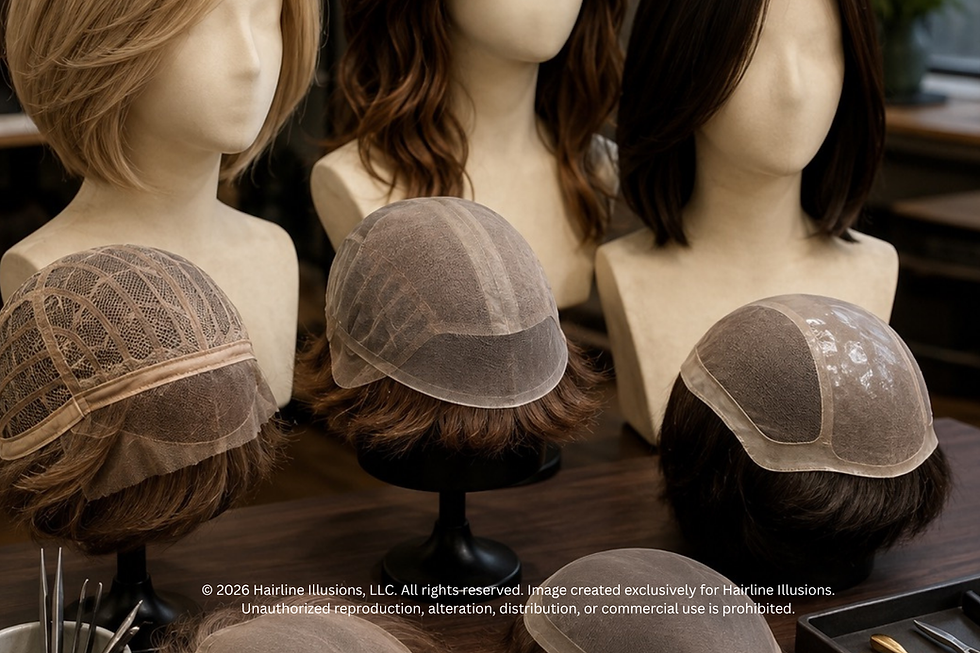
The foundation is the part of the prosthesis that sits against or near the scalp.
Its thickness can influence weight, flexibility, edge visibility, how closely the prosthesis follows the contours of the head, and how the scalp appears through the hair. The amount of solid material covering the scalp can also influence the wearer's experience of heat and moisture.
A thicker material is not automatically poor quality. Thickness may provide structure, durability, strength, or a particular attachment function.
But the client should know what they are choosing.
Ask to see the foundation. Ask how thick it is, how much of the scalp it covers, whether different thicknesses are available, and how the material is expected to feel after several hours of wear.
A prosthesis can look beautiful on a stand and still be wrong for the person who has to wear it all day.
Ask About Ventilation
People frequently use the word breathable when describing wigs and prostheses.
That word alone tells you very little.
A foundation's behavior depends on more than whether air can pass through it. Fit, surface coverage, materials, wear time, activity level, and the condition of the skin all matter.
Research on skin occlusion shows that obstructing normal ventilation can increase hydration of the stratum corneum and affect skin barrier function. This is general skin-occlusion research, not research specifically on cranial prostheses, but it helps explain why airflow should not be treated as the only consideration. [1]
Ask how much of the scalp is covered by solid material. Are there open areas? Can the design be modified if the wearer experiences excessive heat or moisture? How does it perform during exercise or hot weather? Is it intended for continuous wear, or can it be removed easily?
Comfort is not an extra feature. It determines whether the client will actually wear the prosthesis.
Breathability deserves its own discussion because airflow alone does not determine whether a prosthesis will be comfortable or appropriate for a particular scalp. For a deeper explanation, read When Breathability Isn't Enough.
Ask Whether Adhesive Is Required
Some cranial prostheses are designed for adhesive attachment. Others can be worn without it. Some provide several attachment options depending on the client's needs.
There is no universal rule that one method is always superior.
The important thing is knowing what the system requires before purchasing it.
If adhesive is part of the plan, ask where it will contact the scalp, how long the attachment is intended to remain in place, how it is removed, how frequently removal is required, and what alternatives exist if the scalp stops tolerating the product.
That question matters because allergic contact dermatitis has been documented from wig-fixing adhesive tape. A 2023 review of hair-care products also identifies adhesives among the potential allergens encountered in hair products. [2,4]
For some clients, secure bonded wear is exactly what they want.
For others, the ability to remove the prosthesis easily is essential.
The attachment plan should fit the client.
Ask to See the Hairline Up Close
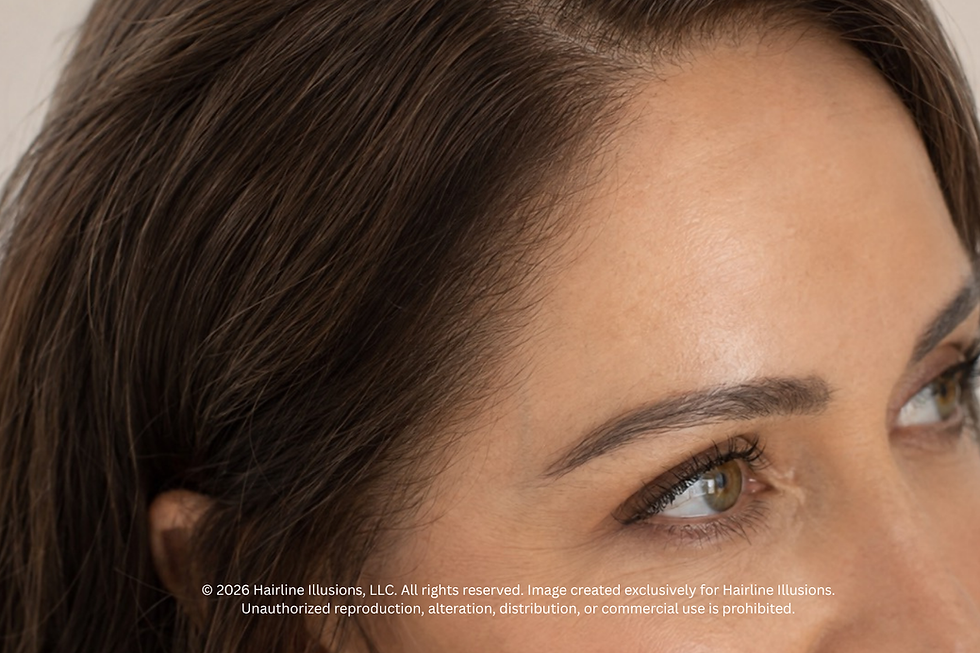
Beautiful hair does not automatically create a natural-looking prosthesis.
The hairline is where construction becomes visible.
Look at the prosthesis from the front and at the temples. Examine the part. Ask to see the hair pulled away from the face.
Pay attention to density at the front, hair direction, knot visibility, temple construction, scalp visibility, and the transition from the first hairs into the fuller density behind them.
A natural hairline rarely has identical density from the first millimeter backward.
If the manufacturer offers custom work, ask how the hairline is designed for the individual client.
A thinner or lower-density hairline is not automatically a more realistic one. Realism depends on whether the density, texture, hair direction, scalp visibility, foundation, and hairline design make sense for the individual wearer.
For a deeper explanation, read Thin Does Not Mean Realistic: The Truth About Natural Looking Wigs.
European Hair Is Not Enough Information
Hair terminology can be confusing.
Words such as European, virgin, Remy, premium, raw, and unprocessed are frequently used as quality signals.
They do not tell the entire story.
Ask whether the hair has been chemically colored or texture processed. Ask whether the cuticle is present and aligned, what the strand diameter is, how color and texture are selected, and what maintenance the hair requires.
Most importantly, ask how the hair is expected to behave after months of washing, styling, environmental exposure, and normal wear.
Hair can look beautiful when a prosthesis is new.
Long-term quality is about how it behaves later.
Ask What Happens if Something Goes Wrong
This is one of the most important conversations to have before buying.
Ask whether the front can be rebuilt, damaged foundation areas repaired, density restored, or the prosthesis resized. Find out whether the attachment method can be changed and whether the foundation itself can be modified if the client's comfort needs change.
Also ask who performs those services. Are repairs completed by the original manufacturer, the provider who sold the prosthesis, or someone else?
A cranial prosthesis may represent a significant financial investment. A relatively small problem should not automatically mean replacing the entire system.
At Hairline Illusions, we see prostheses after they have already been worn. Sometimes a client needs a repair. Sometimes the front needs rebuilding. Sometimes the attachment or foundation needs modification.
That experience has reinforced one principle for us:
A prosthesis should be evaluated not only for how it begins, but for how it can be maintained, repaired, and adapted over time.
Ask Who Actually Manufactures It
The person fitting a prosthesis may not be the person or company that manufactured it.
That is not automatically a problem.
But clients should understand the supply chain.
Find out whether the prosthesis is custom manufactured or altered from a stock product. Ask where it is made, who controls the construction specifications, who performs repairs, and who is responsible if a manufacturing correction becomes necessary.
Knowing who stands behind the actual product becomes especially important after the sale.

Ask About Maintenance Before You Buy
The purchase price is only one part of the cost of ownership.
Some systems require frequent professional maintenance. Others can be maintained primarily at home.
Some require adhesive removal and reattachment. Some eventually require hair additions, foundation repairs, or replacement of particular components.
Before purchasing, ask for a realistic maintenance schedule and expected costs.
A useful question is:
What will this prosthesis require from me over the next year?
That answer may matter as much as the purchase price.

Think About the Child's Real Life
For a child, a prosthesis has to work outside the fitting room.
Think about school, physical education, sports, playgrounds, sleepovers, hot weather, photographs, and the child's ability to manage the prosthesis independently as they get older.
The child also needs a voice in whether they want hair at all.
Adults can become so focused on restoring a child's appearance that the child's preferences disappear from the conversation.
The prosthesis belongs on their head. Their opinion matters.
For more about school support, privacy, physical education, classmates, accommodations, and helping a child decide whether they want a wig or cranial prosthesis, read How to Support a Child With Hair Loss
Do Not Let Urgency Remove Your Questions
Hair loss can create urgency.
Chemotherapy may be starting. School may begin next week. A wedding may be approaching. Someone experiencing sudden hair loss may simply want to feel like themselves again.
That urgency is understandable.
It can also lead people to purchase before they understand what they are buying.
Whenever possible, ask for written specifications. Ask what is custom and what is standard. Ask about repairs, maintenance, attachment, materials, and the foundation.
Most importantly, ask what happens if the prosthesis does not work for you.
A professional provider should be able to explain those things.
When Insurance Does Not Cover the Cost
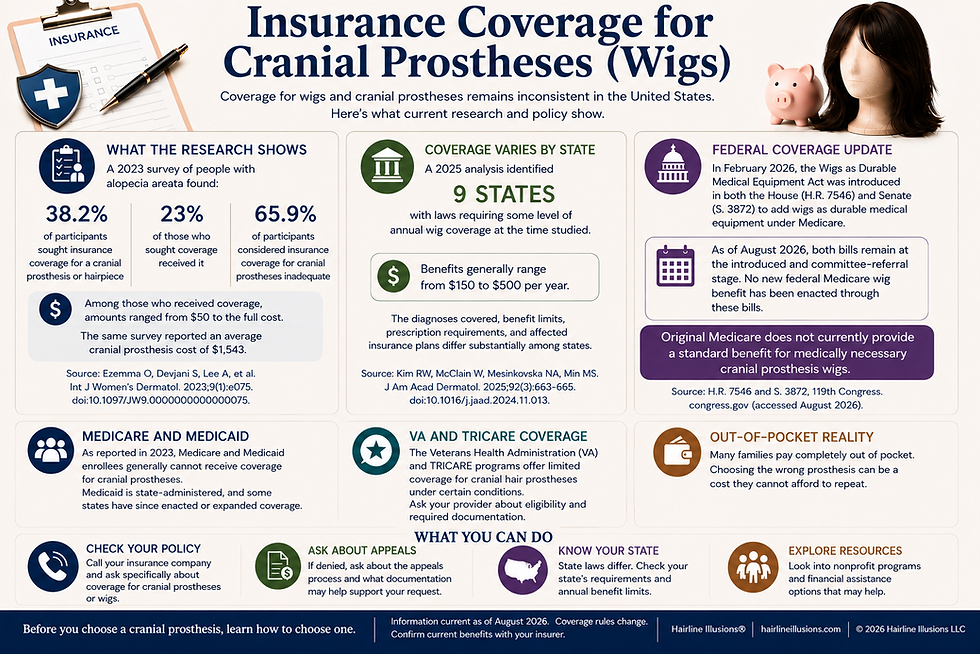
Insurance coverage for cranial prostheses remains inconsistent in the United States.
A 2023 survey of people with alopecia areata found that 38.2% of participants sought insurance coverage for a cranial prosthesis or hairpiece. Of those who sought coverage, only 23% received it. Coverage ranged from $50 to the full cost, and 65.9% of those who received coverage considered the amount inadequate. [3]
Coverage can also depend on where a person lives. A 2025 cross-sectional analysis identified nine states with laws requiring some level of annual wig coverage at the time studied, generally ranging from $150 to $500. The diagnoses covered and other requirements differed substantially among states. Against an average cranial prosthesis cost of $1,543 reported in the alopecia areata survey above, a benefit at the top of that range still leaves most of the purchase unpaid. [5]
Federal coverage remains another issue. In February 2026, legislation was introduced in both the House and Senate to add wigs as durable medical equipment under Medicare. As of August 2026, both bills remain at the introduced and committee-referral stage, so no new federal Medicare wig benefit has been enacted through those bills. [6]
For some families, choosing the wrong prosthesis is therefore not simply disappointing.
They may have saved for months. They may be paying completely out of pocket while also managing medical expenses, housing, transportation, childcare, and lost income.
Sometimes they simply cannot afford to start over.
That reality is one reason we believe people deserve meaningful education before purchasing.
We would rather someone understand what to ask before choosing a prosthesis than discover those questions after the money has already been spent.

Hair That Cares
For families facing financial barriers, Hairline Illusions also provides assistance through Hair That Cares and works in partnership with Butterflies by Blaq Inc., also known as Butterflies BBI.
Butterflies BBI is a registered 501(c)(3) nonprofit organization that provides free hair replacements to qualifying children experiencing medically related hair loss.
Hairline Illusions' Hair That Cares program also provides wig assistance for people experiencing medical hair loss, with support based on program availability and financial need.
The purpose is simple.
A family already carrying the financial burden of illness should not have to carry that burden alone when a child or loved one needs hair.
When assistance, resources, and eligibility allow, these programs provide another path for families who might otherwise be unable to obtain an appropriate hair replacement.
We Want You to Choose Well, Even if You Do Not Choose Us
That may be the most important point in this article.
Education should not be conditional on a sale.
If you ultimately choose Hairline Illusions, we want you to understand why your prosthesis is being designed the way it is.
If you choose another provider, we still want you to know what questions to ask.
Because the real goal is not simply to sell more hair.
It is to reduce the number of people who spend money they cannot afford to lose on something that was never appropriate for them in the first place.
The right cranial prosthesis should account for the scalp.
It should account for the person.
It should account for how they live.
It should account for how the system will be maintained.
And it should account for what happens tomorrow, not only how beautiful it looks today.
Before you choose a cranial prosthesis, learn how to choose one.
That knowledge may be one of the most valuable parts of the investment.
References
Zhai H, Maibach HI. Occlusion vs. skin barrier function. Skin Res Technol. 2002;8(1):1-6. doi:10.1046/j.0909-752x.2001.10311.x
Review of skin occlusion. Occlusion obstructs normal ventilation at the skin surface, increases stratum corneum hydration, and compromises barrier function. General skin research, not specific to scalp or prosthesis wear.
Torchia D, Giorgini S, Gola M, Francalanci S. Allergic contact dermatitis from 2-ethylhexyl acrylate contained in a wig-fixing adhesive tape and its "incidental" therapeutic effect on alopecia areata. Contact Dermatitis. 2008;58(3):170-171. doi:10.1111/j.1600-0536.2007.01212.x
Single case report documenting sensitization to an acrylate in a wig-fixing adhesive tape.
Ezemma O, Devjani S, Lee A, Kelley KJ, Anderson L, Friedland N, Senna M. Patterns of insurance coverage for wigs in patients with alopecia areata: a cross-sectional survey. Int J Womens Dermatol. 2023;9(1):e075. doi:10.1097/JW9.0000000000000075 (open access)
Survey of people with alopecia areata. 38.2% sought insurance coverage for a cranial prosthesis, 23% of those received it, and coverage among recipients ranged from $50 to the full cost. 65.9% considered their coverage inadequate. Average reported cranial prosthesis cost was $1,543.
Karim M, Klein EJ, Nohria A, et al. Potential for allergic contact dermatitis in popular hair care practices and ingredients. Dermatitis. 2023. doi:10.1089/derm.2023.0045
Review of allergens in common hair care practices and products, including adhesives.
Kim RW, McClain W, Mesinkovska NA, Min MS. Legislative efforts to expand insurance coverage of wigs for individuals with medical causes of alopecia. J Am Acad Dermatol. 2025;92(3):663-665. doi:10.1016/j.jaad.2024.11.013
Cross-sectional analysis of state legislative databases. Nine states had laws requiring annual wig coverage, generally $150 to $500 per year. Three applied only to alopecia areata and five only to cancer-related alopecia. The paper also notes that Veterans Affairs and TRICARE provide limited cranial hair prosthesis coverage.
Wigs as Durable Medical Equipment Act, H.R. 7546, S. 3872, 119th Cong. (2026). https://www.congress.gov/bill/119th-congress/house-bill/7546
Introduced February 12, 2026, to amend title XVIII of the Social Security Act to provide Medicare coverage for wigs as durable medical equipment. Both bills remained at the introduced and referred stage as of August 2026.
National Alopecia Areata Foundation. Insurance coverage for wigs and cranial prostheses. Accessed August 2026. https://www.naaf.org
Practical guidance on verifying benefits, obtaining a prescription, assembling documentation, filing claims, and appealing denials.
© 2026 Hairline Illusions LLC. All rights reserved. This article is provided for educational purposes and does not constitute medical advice. No part of this content may be reproduced, republished, or distributed without written permission.


Comments